GSC Meeting in Samarkand
on 20 September 2026, 11:00 – 13:00
Report by Pavel Tregubov
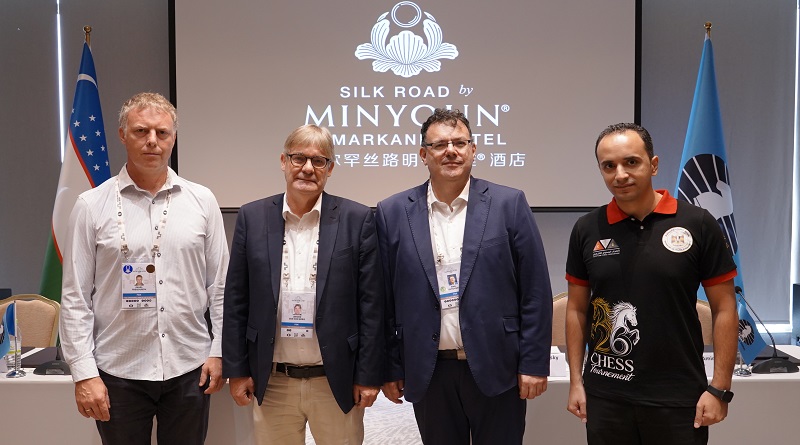
PRESENT:
| FIDE Interim President | Viswanathan Anand |
| GSC Chairman | Emil Sutovsky |
| GSC Secretary | Pavel Tregubov |
| GSC Councillors | Bassem Amin Jeroen van den Berg |
| Guests in the Room | Nitin Narang John Fernandez Rustam Kaiyrbekov Juergen Klueners Almong Burstein Susan Namangale Shaun Press Gerhard Bertagnolli Margit Brokko Alan Shulman Dharmendra Kumar Dorian-Ciprian David Raju Tamrakar Eloi Relange Robert Katende Brian Yang Adout Madit Oscar Consuegra |
| Online Guests | Magyar Sakkszövetség Attila Kasa |
Summary
I. GSC Chairman Emil Sutovsky reports
The GSC Chairman, Emil Sutovsky, opened the meeting with a welcome address and then proceeded to present the annual report.
He began by reviewing the main events that had taken place since the previous General Assembly.
The first major GSC event was the World Rapid and Blitz Championship held in Doha in December 2025. The event was successfully organised, with a record number of participants. The local organisers expressed their interest in continuing their cooperation with FIDE. Qatar can potentially host one of the future Chess Olympiads in the coming years.
The next major event was the Candidates Tournament held in April this year. It was a good example of cooperation between FIDE and the local organisers. The Cap St Georges Hotel also participated as one of the organisers and partners of the event. The hotel has also expressed interest in hosting future FIDE events.
The next major event was the World Team Rapid and Blitz Championship held in Hong Kong in June this year. It was the fourth edition. The event attracted significant interest from teams. It was noted as a particularly good example of combining participation by top-level players with amateur, mostly young players.
Emil Sutovsky then referred to the Chess Olympiad currently taking place in Samarkand, where the present meeting is being held. The Chairman expressed his appreciation to the organisers for the excellent organisation, the outstanding playing hall, and the record number of participating teams.
The Chairman then presented the Total Chess project as another important initiative. He noted that he had been directly involved in the negotiations with the Norway Chess concerning the implementation of the project. The project presents significant organisational challenges, particularly in terms of sponsorship, scheduling, and the integration of a large number of events into an already complex international chess calendar. The pilot event is scheduled to take place in Budapest this year.
It was emphasised that the Total Chess World Championship will not replace the existing FIDE World Championship in classical chess.
The Chairman also highlighted the variety of formats envisaged within the project, including a combination of classical chess with shorter time controls, rapid chess and blitz.
Different views exist regarding the introduction of new formats. Some consider that FIDE is experimenting with too many different formats and that it would be preferable to focus on a single established format. Emil Sutovsky noted, however, that FIDE considers it important, to continue exploring new approaches to its promotion and development.
In the long term, one of the key objectives is to establish a stable system comprising tournaments with different formats, brought together under the FIDE umbrella. The FIDE Circuit was cited as an example of such an approach. It was noted, however, that the tournaments forming part of the FIDE Circuit are independently organised events, while FIDE brings them together within a points system and does not act as the organiser or co-organiser of each individual tournament.
The next major project will be the World Championship Match between the reigning World Champion Gukesh D and the challenger Javokhir Sindarov. The opening ceremony of the match will take place at the Palais des Nations in Geneva on 22 November.
It was also noted that FIDE has recently concluded the largest sponsorship agreement in its history with Salesforce, covering a three-year period. The sponsorship part of the agreement stands on USD 9M, but it is also about a major technological partnership with the one of the world’s leading companies.
The agreement has two main components. The first is direct sponsorship of the World Championship Matches in 2026 and 2028, with the 2028 match expected to take place in San Francisco, as well as sponsorship of the Women’s World Championship Match in 2027.
The second component concerns the development of the FIDE online platform (see below).
Another important project that has attracted considerable attention from the chess community this year is the change to the format of the FIDE World Cup.
Following an analysis of last year’s World Cup in India, it was observed that interest from the chess community tended to decline towards the later stages of the event. This was attributed primarily to the length of the tournament, which lasted 28 days. It was noted that very few sporting events, if any, are conducted over such an extended period.
The new format significantly reduces the overall duration of the competition and also increases the number of qualification places allocated to continental qualification quotas.
The prize fund will also be increased significantly, particularly for the Women’s World Cup. Furthermore, the new group stage format is intended to reduce the negative impact associated with the knockout format, where players may play only two games and the cost of a single mistake is extremely high, potentially resulting in immediate elimination from the tournament.
The new time control, referred to as ‘fast classical’, which has recently been introduced in other FIDE World Team Championships, will also be applied during the first stage of the World Cup.
Regarding other sponsorship projects, it was noted that Freedom Holding will also be the general partner of the World Championship Match, and that cooperation with FIDE has now continued for three years. This was highlighted as an important development for FIDE.
It was also noted that an agreement with Chess.com has been concluded and will remain in effect until the end of 2026.
Interim President Viswanathan Anand then joined the meeting. He thanked the Commission for its productive work, in particular for its efforts in attracting sponsors and organising major events.
II. Homogeneity vs variety. Shall FIDE further standardize and set a very limited number of time controls. in the events of the World Championship Cycle.
Emil Sutovsky initiated a discussion on whether different time controls should be standardised or maintained. He explained that different time controls are used in different tournaments depending on the objectives of the event and the preferences and expectations of the audience.
Various views were expressed during the discussion, which involved the GSC members present as well as guests.
One of the guests raised a question as to why different time controls are used in women’s tournaments compared with men’s tournaments.
Pavel Tregubov responded that FIDE takes players’ views into consideration and that polls conducted among top players have indicated that women and men have different preferences regarding time controls.
It was noted that combining different time controls does not have a negative impact. It was also observed that professional chess players generally adapt relatively easily to different time controls. It was also noted that different formats exist at the highest level in other sports as well, and that this is considered a normal practice. The majority of speakers stated that there was no need to standardise the time controls.
The Chairman of the Qualification Commission, Sean Press, expressed the view that accelerated time controls, such as ‘fast classical’, could have a negative impact on the awarding of direct FIDE international titles in tournaments held as part of the World Championship cycle. He proposed closer cooperation between the GSC and the Qualification Commission on this matter.
III. FIDE online platform: engaging and educating.
Emil Sutovsky explained that the FIDE online platform will be developed in collaboration with Salesforce. It will support and expand various areas of FIDE’s activities and provide a range of services. These are expected to include educational programs, rating-related services and other chess-related functionalities.
It was noted that not all details of the platform have yet been finalised, but the project has significant potential.